The sun is a few hundred times the room.
This is the number that decides whether an indoor wall can be used outside, and the answer is almost always no.
Direct sunlight falling on a surface can exceed 100,000 lux. A well-lit ballroom is a few hundred. Between those two figures sits every complaint anyone has ever made about a screen being washed out at two in the afternoon — it is not a content problem or a contrast setting, it is three orders of magnitude.
Panel brightness is specified in nits. An indoor wall is specified in the hundreds of them, because indoors the wall is the brightest object present and anything more is uncomfortable to sit in front of. A wall intended to hold an image in daylight is specified in the thousands. They are different products, and the difference is not a setting that can be turned up on the day.
The same arithmetic is what separates a wall from a projected image indoors, and there it is decisive rather than merely important: light in the space lands on a projection screen and raises its black, while an emissive surface only has to contend with what reflects off the panel face. Worked through with the published contrast standard, in LED wall or projection.
What actually helps
- Which way it faces. A wall with the sun behind it is a silhouette; a wall with the sun on its face has the worst of it. Orientation is free at the site-plan stage and impossible on the day, so it is the first thing worth deciding.
- What time the show is. An event that starts at four and runs to nine solves its own problem halfway through. One that peaks at one in the afternoon does not, and that is a specification decision rather than something to discover.
- Shade, if the site has any. A roof, a structure or the building the event is against changes the requirement more than any adjustment to the wall does.
- Content built for the conditions. Fine detail and low-contrast grading survive indoors and disappear in sun. Large type and strong separation survive both, so they are what gets designed when the room is a field.
The other half of daylight is the part nobody expects: the same wall at nine in the evening is far too bright for the people standing in front of it, so it is brought down through the show rather than set once. A build for an outdoor event is specified for the worst hour and run for all of them.
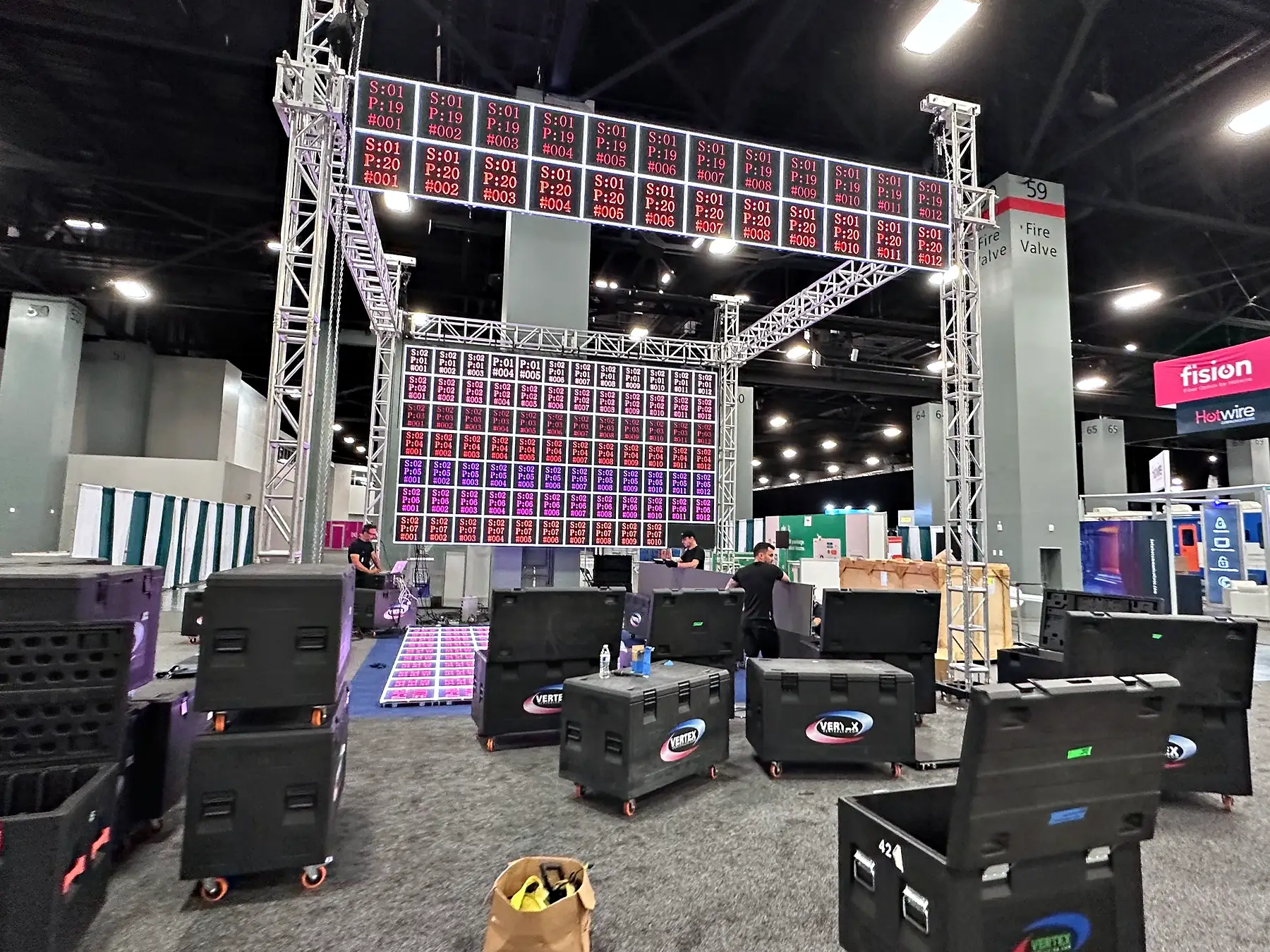
Five hundred square feet of flat surface.
A wall outdoors is a sail with a picture on it. What that means is calculable, and it is calculated before anything is built.
Take a wall 30 feet wide and 18 feet high — 540 square feet of flat, solid surface standing square to whatever is blowing across the site. The standard starting point for wind on a structure is the velocity pressure, which for wind speed in miles per hour and pressure in pounds per square foot is 0.00256 × V².
At 40 mph
0.00256 × 40² = 0.00256 × 1,600 = 4.1 lb/ft²
4.1 lb/ft² × 540 ft²
≈ 2,200 lb of force on the face
At 60 mph
0.00256 × 60² = 0.00256 × 3,600 = 9.2 lb/ft²
9.2 lb/ft² × 540 ft²
≈ 5,000 lb of force on the face
Half again the wind speed is more than twice the load, because the relationship is a square. That is the single most important thing on this page: the difference between a breezy afternoon and a squall line is not a matter of degree, and a structure that is comfortable at 40 has not got much margin left at 60.
Both figures above are velocity pressure only. A real calculation applies a force coefficient on top, and a flat panel standing square to the flow carries one above 1.0 — so the numbers a structural engineer works to are larger than these, not smaller. This arithmetic is where that conversation starts, not where it finishes. It is what the answers below are built on.
What the load buys you, in decisions
- Ground support, not flown. Outdoors there is usually nothing to hang from, so the wall stands on a structure — towers and a header — which is heavier, wants more floor behind and beside it, and costs sightlines. That structure is engineered and it comes with a rating.
- Ballast or anchoring, and it depends on the ground. Grass, asphalt and a deck are three different problems. Anchoring into a surface somebody else owns is a permission, and permissions have lead times.
- A wind action plan with numbers in it. A rating is only useful if somebody is watching the forecast against it and somebody has the authority to call it. The threshold, who monitors it, and what happens at it are agreed in advance and written down.
- Time to act. Lowering or clearing a structure is not instant. The plan has to work backwards from how long it actually takes, which is why the decision point is set well below the rating.
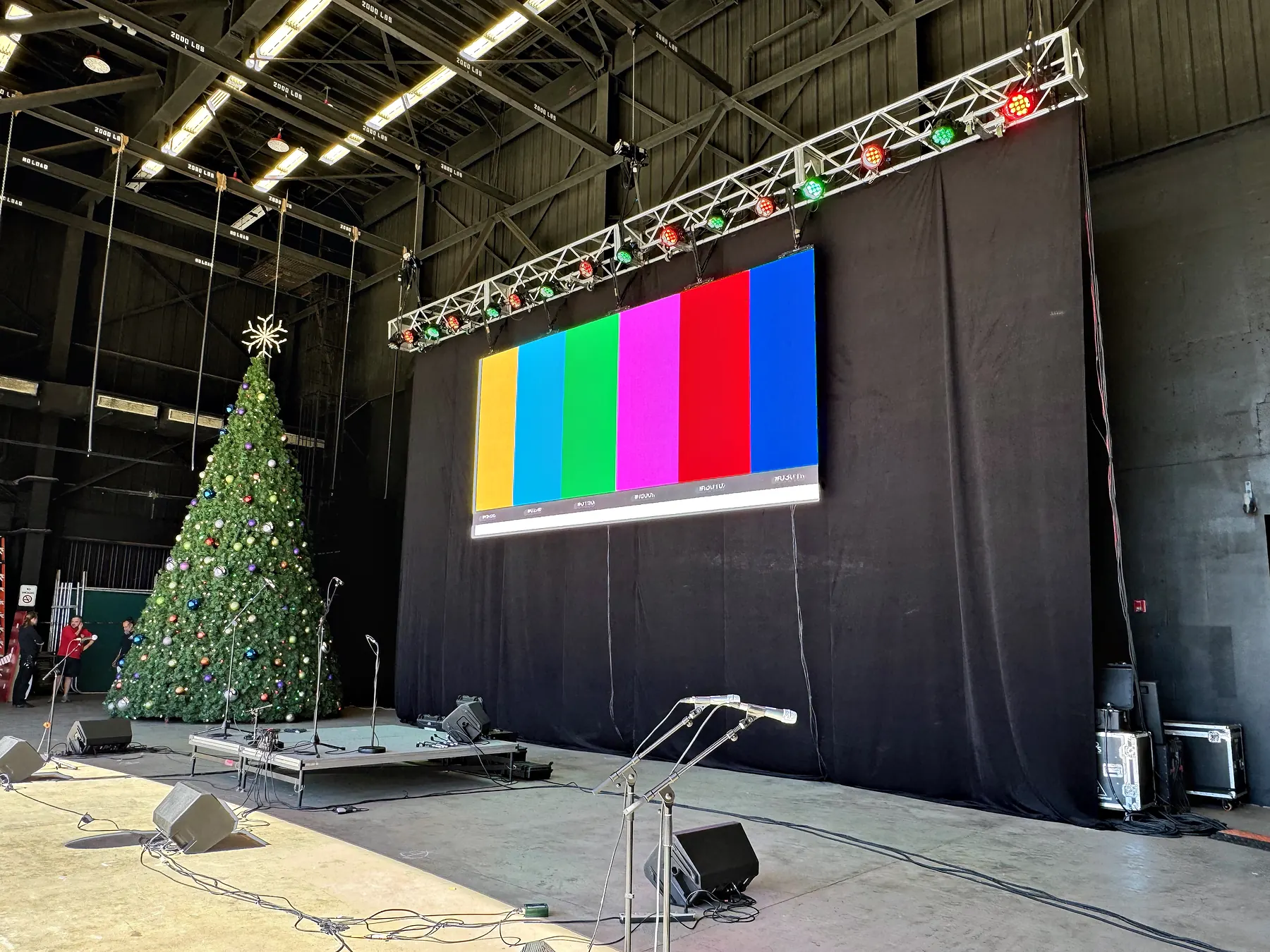
Dust-tight and rated for water, or it does not go outside.
Everything downstream of the panels has to survive the same afternoon the panels do.
- Ingress rating
Outdoor panels carry an IP rating under the international standard for enclosure protection. The common outdoor specification is IP65: the first digit is dust — 6 is dust-tight — and the second is water, where 5 means protected against jets from any direction. It is a property of the panel, and an indoor panel does not acquire it by having a tarpaulin over it.
- The back of the wall
The rating covers the panels. Processing, distribution, power termination and data all live behind the wall and need their own protection, their own elevation off a surface that may be holding water, and a path for it to drain. This is the part of an outdoor build that most often fails, and it fails quietly until it does not.
- Heat
A dark surface in Florida sun gets hot on its own before anything is switched on, and the panels generate heat of their own. Ventilation behind the wall is part of the design rather than a consequence of how it happens to be built.
- Power at a distance
Outdoors, the wall is rarely near the power. Long runs, voltage drop over those runs, and cable protection across ground that the public walks on are all part of the same build. The full average-against- maximum arithmetic for a wall this size is worked through on the case study linked below.
- Getting it there
A ground-support wall arrives on a truck that has to reach the spot. Grass after rain, a site with one gate, a load-in that shares a road with the public, and a build sequence where the structure has to go up before anything else can — all of it is scheduled from the site, not from the equipment.
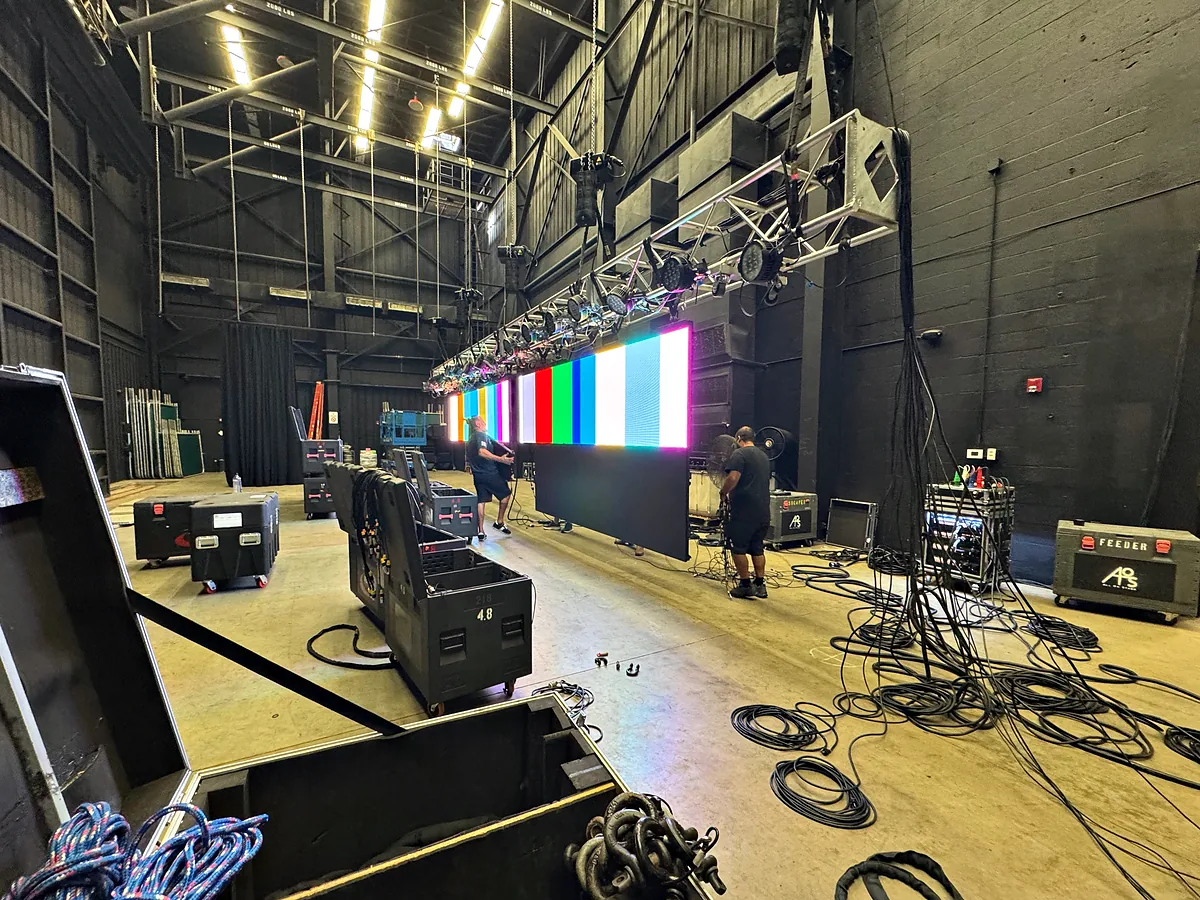
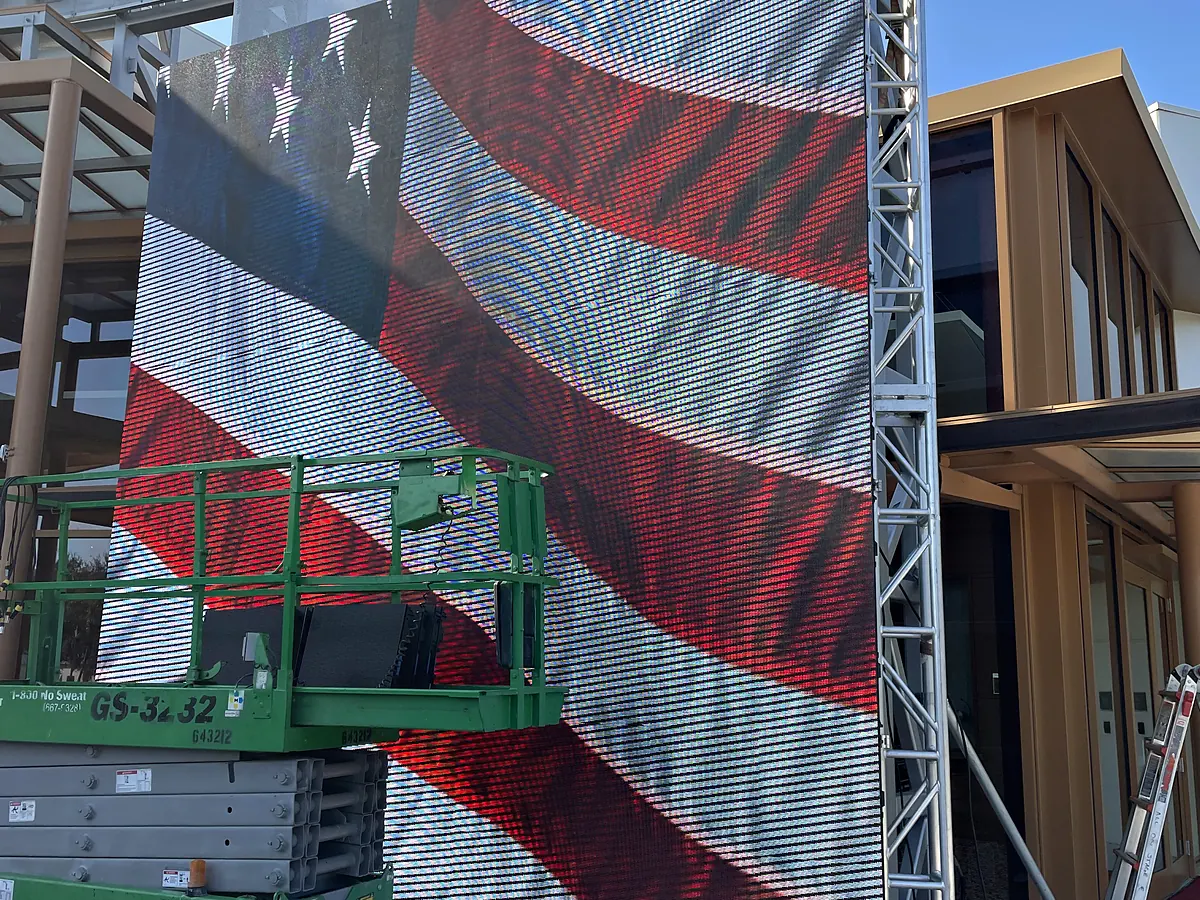
A wall shot badly bands on the recording.
An LED wall does not emit continuously — it refreshes, and a camera samples. Where the panel's refresh behavior and the camera's frame and shutter settings do not agree, the recording shows bands or a flicker that nobody in the field can see. It is a specification question about the panels and a settings question at the camera, and it is settled at rehearsal by looking at a monitor rather than at the wall.
Two more that only appear through a lens. A wall behind a presenter is a large, bright light source pointed at the back of their head, which is a lighting problem before it is a video one — the color of what is on the wall lands on their shoulders. And a camera resolving the pixel structure of the wall itself produces moiré, which is a distance and an angle problem rather than something correctable afterward.
Six answers, and the build follows.
Every one of them is about the site and the schedule. None is about the panels.
Indoors or out
It decides the panel, not just the specification
Time of day
What the sun is doing during the hours that matter
The ground
Grass, asphalt or deck — it decides how it stands up
Size and aspect
Where the near and far seats are, and what the content is
Power and distance
Where the supply is, and how far it has to travel
Who calls the weather
The threshold, the monitor, and the time to act on it
If the event is indoors, most of this page does not apply and the questions become pitch, seating distance and what the building will let you hang. Those are worked through in full, with the arithmetic, on the case study below.
Where the figures come from
- 100,000 lux, and a few hundred — the order of magnitude of illuminance from direct sunlight on a surface, against a well-lit interior. Both are standard reference figures and both vary — §01 gives them as an order of magnitude because that is the size of the claim.
- 0.00256 × V² — the standard velocity-pressure relationship used in United States structural wind design, giving pounds per square foot from miles per hour. Both figures in §02 are worked from it on the page. It is velocity pressure only: a force coefficient applies on top and raises the result.
- 540 ft² — 30 ft × 18 ft, multiplied on the page. The same dimensions as the wall on the linked case study, so the two sets of arithmetic can be read against each other.
- IP65 — the ingress protection classification under IEC 60529. First digit 6, dust-tight; second digit 5, protected against water jets from any direction.