Speech and music are not the same specification.
They are routinely treated as one system with the level changed. They are two problems that want opposite things from the same room.
Speech is an intelligibility problem. What matters is that consonants survive the trip from the microphone to the back row — and consonants are the quiet, brief, high-frequency part of speech, which is exactly the part a reverberant room smears into the vowel that came before it. Making it louder does not fix it. It makes the smearing louder too. The answers are directional control, getting the source closer to the listener, and keeping energy off the surfaces that are causing the problem.
Music is a headroom problem. A system that is comfortable for a presenter at conversational level has to hold a drum kit and a bass rig without running out of room at the top, and the peaks in live music sit far above its average level. Undersize it and the first thing that goes is not volume but clarity, because everything is being asked to work at the edge of what it can do.
Most events are both, in the same room, on the same day. A general session at nine in the morning and a band at seven in the evening is one load-in and two designs, and the honest version of that is a system specified for the harder of the two with the gentler one run well inside it. It is the wrong way round to specify for the speeches and hope the band fits.
Every doubling costs you about six decibels.
This is the number that decides whether a room needs one system or three, and it is the one most often discovered on site.
Sound pressure from a point source in the open falls by roughly 6 dB each time the distance from it doubles. It is a geometric fact about energy spreading over a sphere, not a property of any particular equipment, and it is unforgiving over a long room:
- 30 ftthe front row — reference
- 60 ftone doubling — about 6 dB down
- 120 fttwo doublings — about 12 dB down
- 240 ftthree doublings — about 18 dB down
Eighteen decibels is not a trim adjustment. To land the same level at 240 feet from the stage alone, the front row would have to absorb all of it, and the front row is where the people are. So a long room and an open field get another system closer to the listener rather than a bigger one at the front. That is what delay positions are for, and it is why a site plan matters more to an audio design than an equipment list does.
A second system introduces its own problem, and it is a timing problem. Sound from the stage is still traveling; sound from the delay tower starts at the tower. If the two arrive together the listener hears a doubled, hollow version of the show, so the nearer system is held back until the further one catches up.
Working it out
Sound travels about 1,125 feet per second in dry air at 68 °F. A delay position 240 feet downfield is therefore:
240 ft ÷ 1,125 ft/s = 0.213 s
≈ 213 milliseconds of delay
Then it is pushed a little later still — commonly another ten to twenty milliseconds. Within roughly the first 30 ms the ear localizes a sound to whichever version arrives first, so arriving fractionally after the stage keeps the show sounding like it is coming from the stage, even though nearly all of the level at that position is coming from a tower forty feet away.
And it moves during the day
The speed of sound rises with temperature — very close to 1.1 feet per second for every degree Fahrenheit. An outdoor show that loads in at 70 °F and goes up at 95 °F has changed the arithmetic under itself:
at 70 °F — 240 ft ÷ 1,129 ft/s ≈ 213 ms
at 95 °F — 240 ft ÷ 1,156 ft/s ≈ 208 ms
about 5 ms of drift across one afternoon
Five milliseconds is small, and it is well inside the window where the image still holds. It is published here because it is the reason a delay time is checked again at soundcheck instead of being set once at load-in and written down — and because wind does a larger and less predictable version of the same thing, bending the path rather than shortening it.
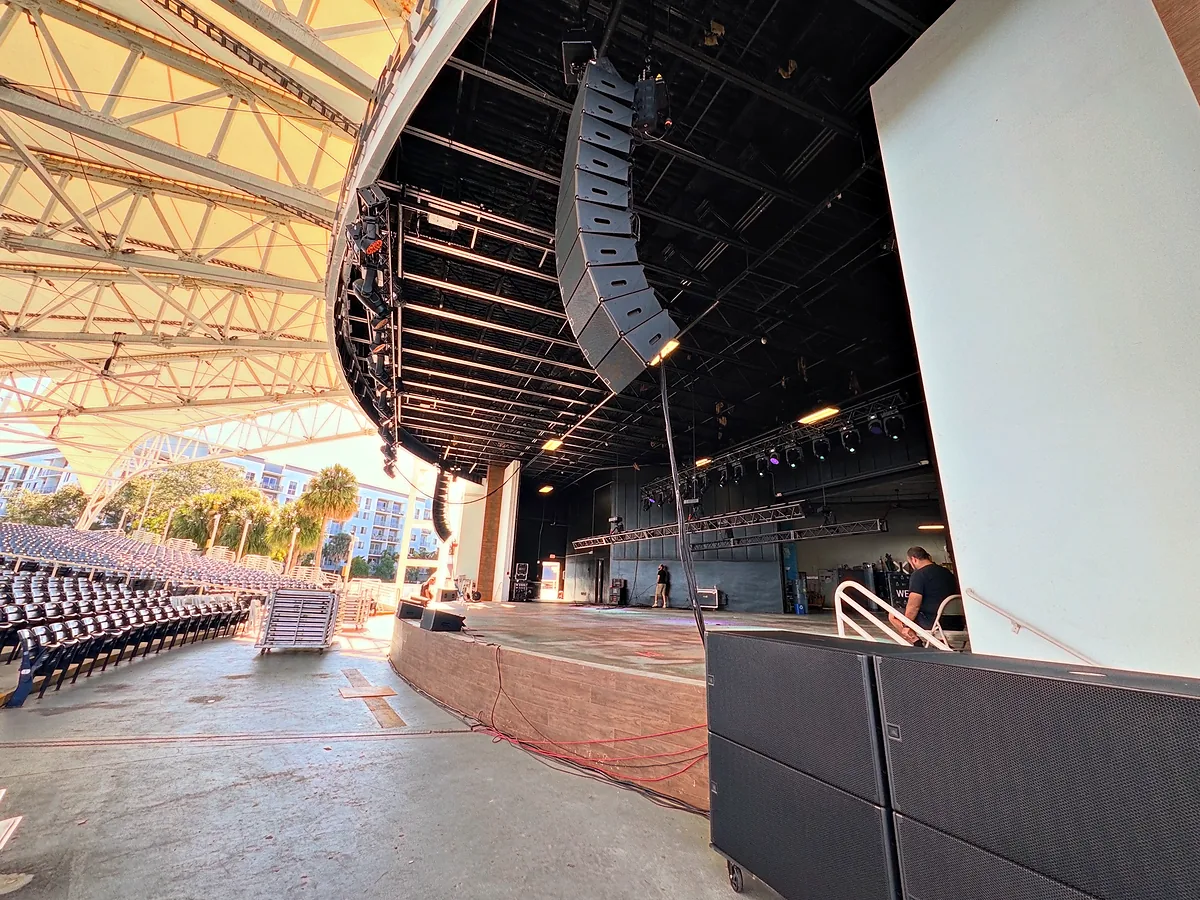
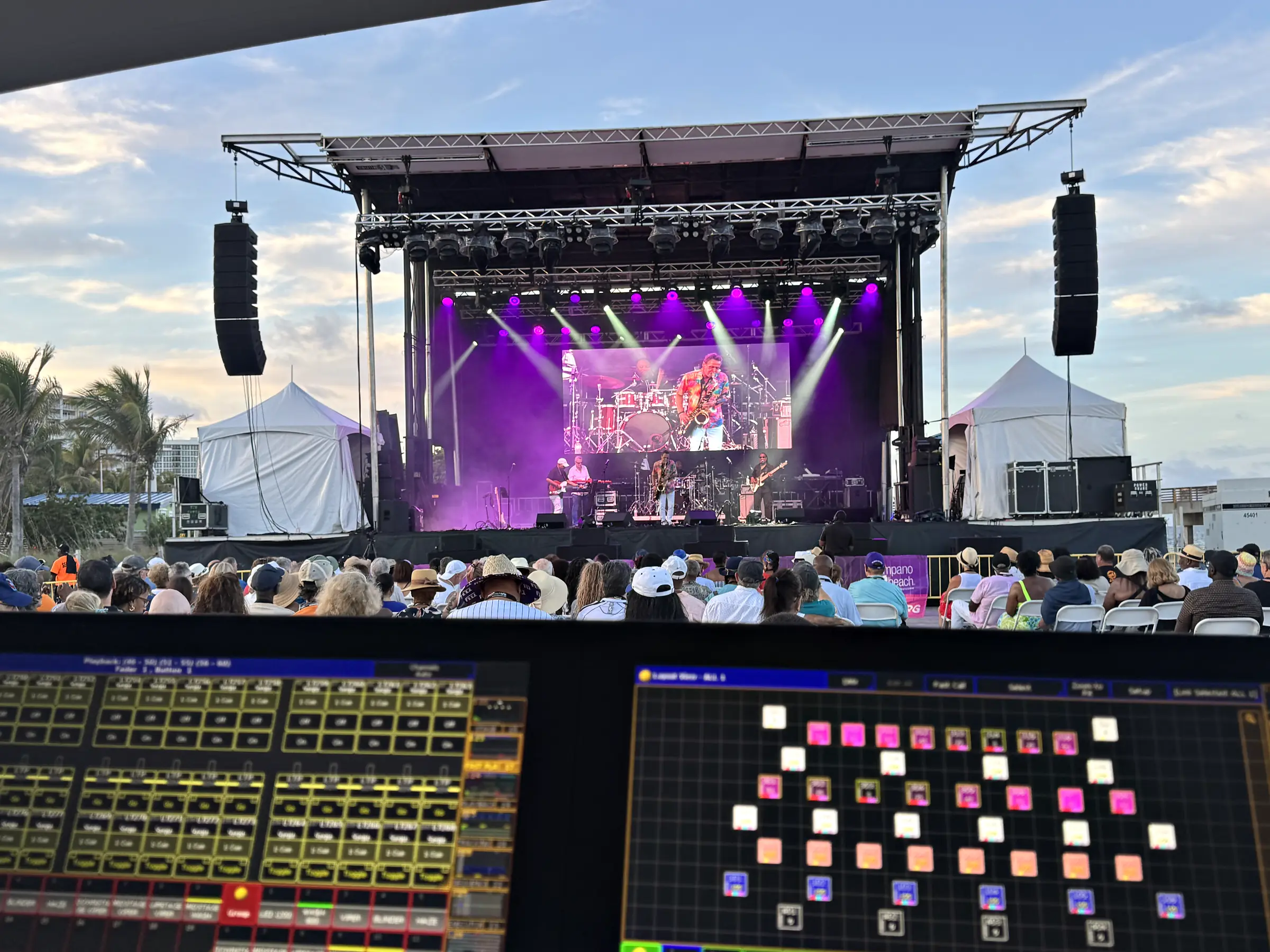
Indoors the room is the problem. Outdoors it is the distance.
The two are not degrees of the same job. They fail differently and they are solved differently.
- Reverberation
A hard ballroom with a tile or terrazzo floor, glass on one wall and a coffered ceiling keeps the energy in the room long after the talker has stopped. That tail is what eats consonants. Directional control — keeping the pattern on the audience and off the back wall — does more for intelligibility than any amount of level.
- Bodies absorb
The same room is measurably different empty and full, and it is different again at four in the afternoon and at eight in the evening. An audience is a large area of soft, irregular absorption. A system tuned to an empty room at rehearsal is tuned to a room that will not exist during the show, which is why the tuning gets a second look once people are in it.
- Open air
Outdoors there is almost nothing to reflect off, so reverberation stops being the problem and coverage becomes it. There is no ceiling to reinforce the back of the field and no walls to keep it in — just the six decibels a doubling in §02, all the way to the fence.
- Wind and gradients
Moving air bends sound. A breeze across the site carries the far side of the field and robs the near one, and it changes through the evening. Warm air near the ground over cool air above it refracts energy upward and away from the audience. Neither is fixable from the mix position; both are reasons a design leaves margin rather than sitting exactly on the minimum that works at soundcheck.
- What is over the fence
An outdoor show has neighbors and usually an ordinance, and the limit is written at the property line rather than at the mix position. That is a design input on the same footing as coverage, because the two pull against each other: the arrangement that reaches the back of the field with the least energy leaving the site is not the loudest one, it is the most directional one.
Wireless is a licensing question before it is a technical one.
There is less usable radio space for microphones than there was ten years ago, and how much less depends on the building you are standing in.
In the FCC's 600 MHz transition, wireless microphone operation in 617–652 MHz and 663–698 MHz had to cease by July 13, 2020. That spectrum went to mobile carriers. Equipment built for it did not become worse at its job; it became illegal to operate, and a great deal of it is still in circulation.
What is left for most event use is the UHF television band below that, roughly 470–608 MHz — and what is actually usable inside that range is a local question, because the answer is whatever the television stations receivable at that address are not already using. The same set of frequencies that runs cleanly in one county can be unusable thirty miles away.
So coordination is done as a scan, in the actual room, and repeated on show day rather than assumed from the last event in the same building. The practical consequences are worth knowing before a run sheet is written:
- Channel count is finite and it is not a budget decision. Every additional wireless channel has to fit in the space left over, with room between it and its neighbors.
- Handhelds, lavaliers, in-ear monitors and intercom are all competing for the same shrinking band, and in-ears transmit continuously.
- Antenna position matters more than transmitter power. Line of sight to where the presenter is actually going to stand beats any amount of level, and the body of the person wearing the pack is the most common obstruction.
- A convention center with three other events in it is a different RF environment every hour of the day.
Where the channel count is genuinely tight, the design answer is usually to spend fewer channels rather than to squeeze more in — a wired lectern microphone that never drops out is better production than a fifteenth wireless that might.
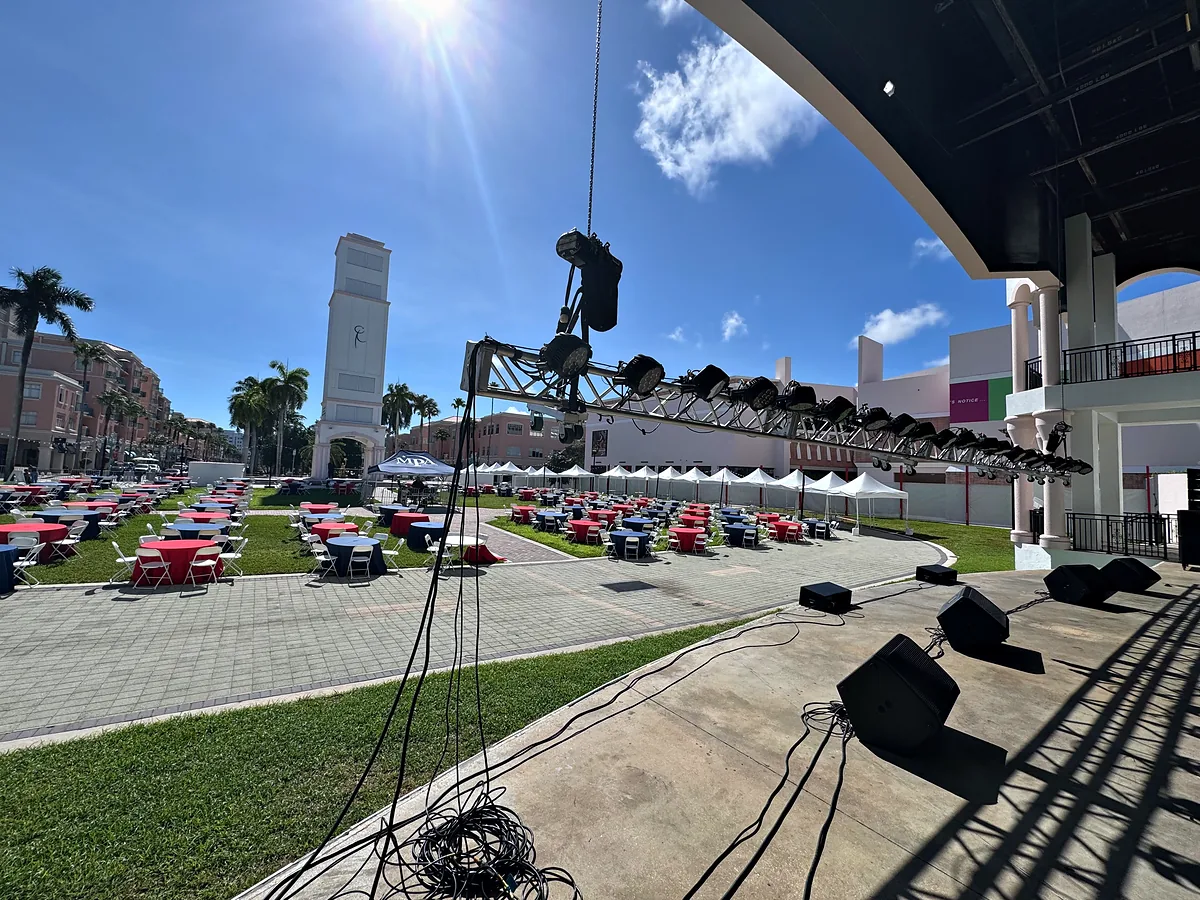
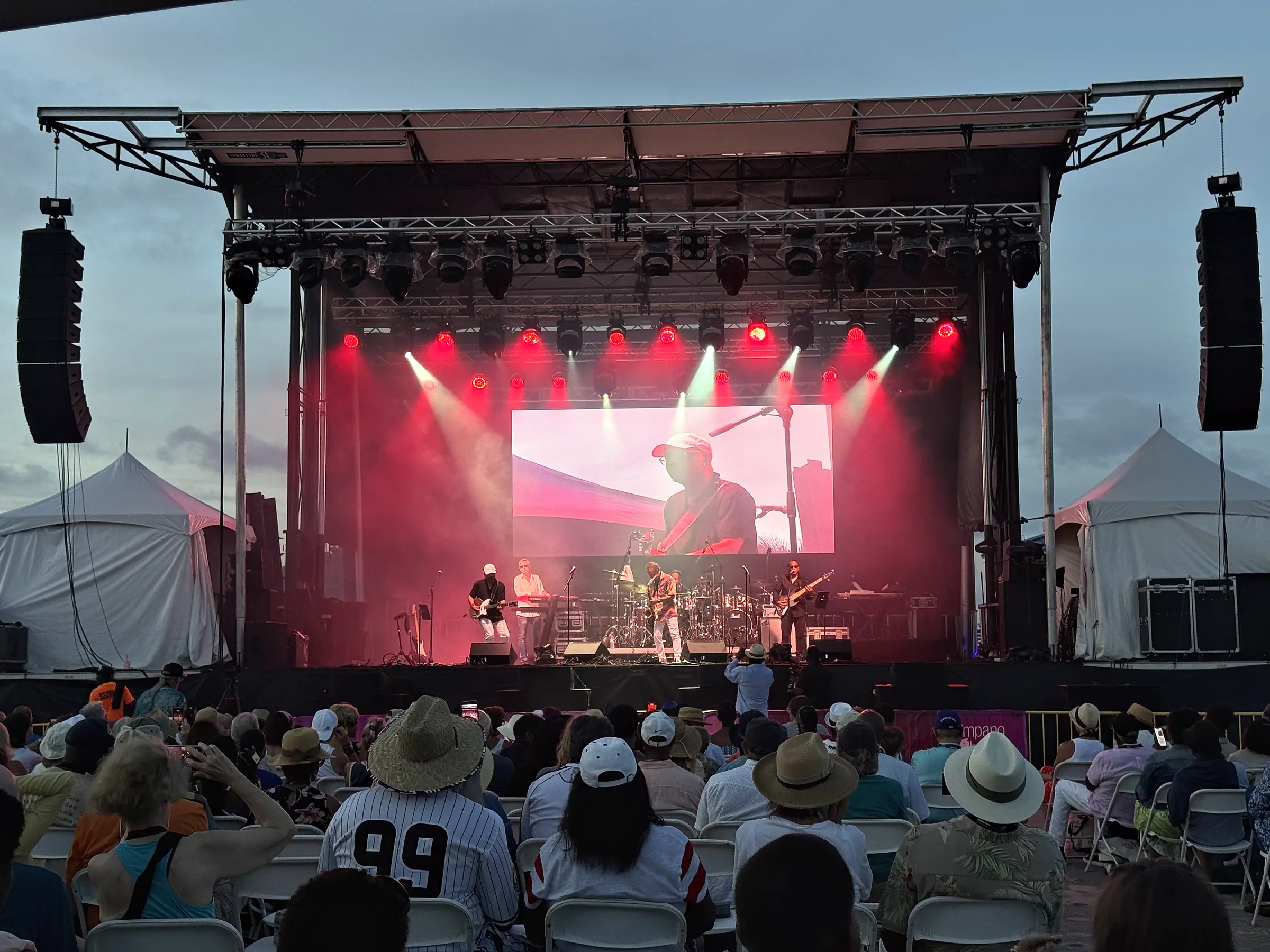
Six answers, and the design follows.
None of these is a question about equipment. Each one changes the system, which is why they come first.
The far seat
Distance from the stage to the last row — the number §02 runs on
Open microphones
How many, wired or wireless, and where they move
Anybody playing
Speech, music, or both in one day
The surfaces
Ceiling, floor and walls — or no room at all
The property line
Outdoors, where the limit is written and who is next door
Who else is listening
A record, a stream or a press feed is its own output
If the show needs it, we have it. That is the last part of the conversation rather than the first, and it is why this page has no equipment list on it. What is worth talking through early is the room, the field, the schedule and the far seat — those are what a system is designed against, and they are the things that cannot be changed later.
Where the figures come from
- 6 dB per doubling of distance — the inverse-square relationship for a point source radiating into free space. Standard acoustics; a property of geometry rather than of any equipment.
- 1,125 ft/s, and 1.1 ft/s per °F — the speed of sound in dry air at 68 °F and its temperature coefficient near room temperature. Both delay figures in §02 are computed from them on the page and rounded to the nearest millisecond.
- Roughly 30 ms for the precedence effect — the window within which a listener localizes a sound to the first arrival rather than the louder one. A described threshold rather than a sharp edge, which is why §02 says "roughly".
- 617–652 MHz, 663–698 MHz, July 13, 2020 — the bands wireless microphone operations had to vacate, and the deadline by which they had to do it, under the FCC's 600 MHz transition following the broadcast incentive auction.